

Marketing technology
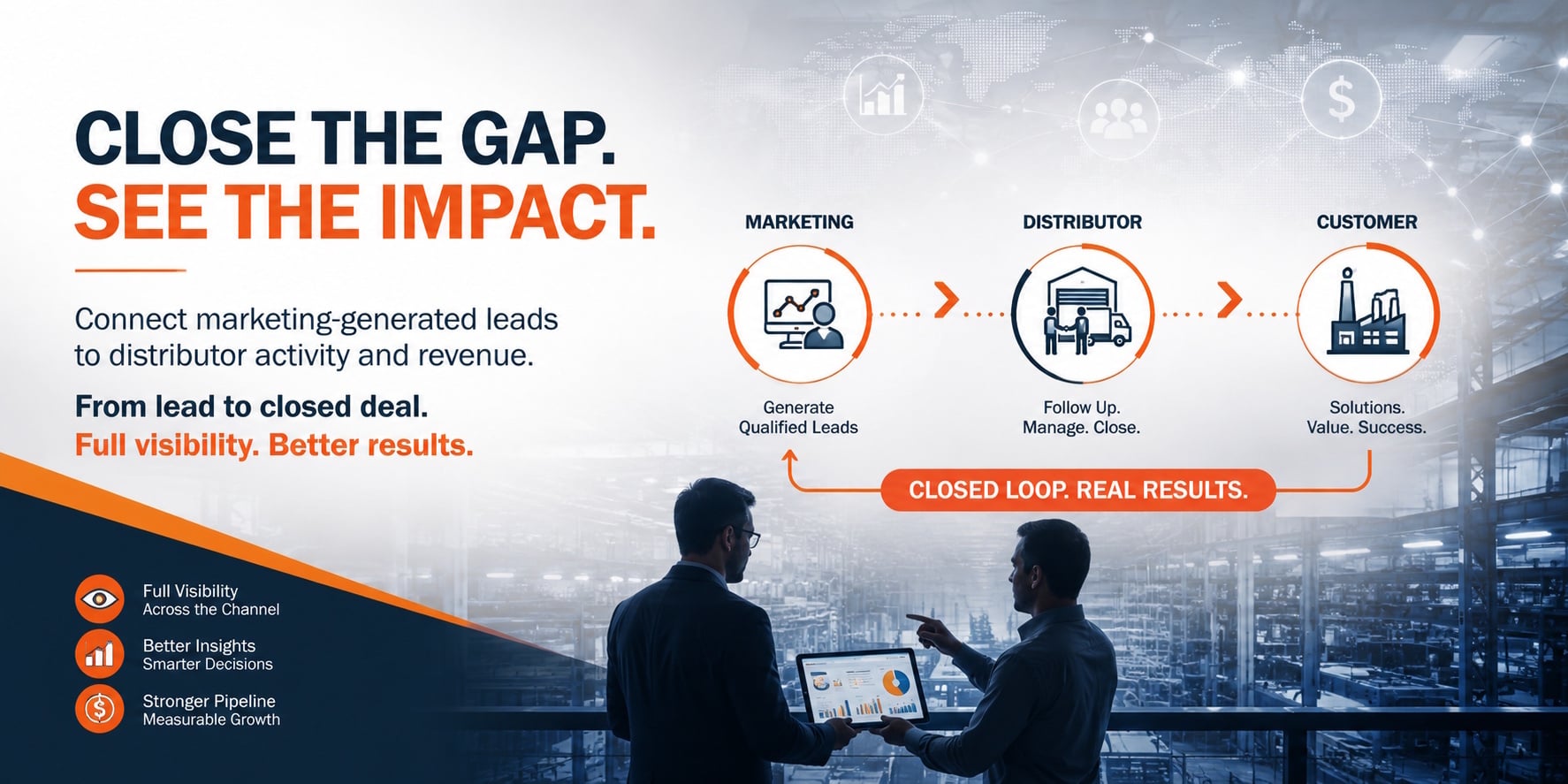

Many B2B companies, especially in industrial manufacturing, have achieved decades of growth while selling their products indirectly — typically through networks of distributors, representatives, dealers, and other channel partners, both domestically and overseas.
What may sometimes be perceived today as an archaic business model has actually been tremendously successful.
Distributors don't simply resell products. Historically, they have extended manufacturers' capabilities by providing local market knowledge, application and product support, inventory, returns and replacements, on-site service, and established relationships with end users.
For manufacturers with specialized products and customers spread across industries and geographies, that model makes a lot of sense.
For marketing, however, it creates a significant problem:
What happens to a lead after it leaves the manufacturer?
Consider a fairly typical scenario.
A manufacturer invests in SEO, paid search, trade shows, content, email campaigns, social media, and its website. A prospective customer visits the website, researches a product and eventually submits a request for information or quote.
Great. Marketing generated a lead.
The lead enters the manufacturer's CRM or marketing automation platform. Based on geography, product line or application, it is then routed to the appropriate distributor.
And that's where visibility often ends.
The distributor receives the lead by email, phone, spreadsheet or some other notification. Its salesperson contacts the prospect and begins working the opportunity.
Meanwhile, the manufacturer's CRM still says:
Lead assigned to distributor.
Did the distributor contact the customer?
Was the lead qualified?
Was a quote created?
How large was the opportunity?
Was the opportunity lost?
Was it won?
How much revenue did it ultimately generate?
In many organizations, nobody really knows—or someone has to start sending emails and making phone calls to find out.
It's easy to blame channel partners for poor follow-up or incomplete reporting, but that's often unfair.
The manufacturer and distributor are two separate companies operating with different systems, processes and priorities.
A manufacturer's sales team may live in its CRM all day. A distributor's salesperson probably doesn't.
That distributor may represent dozens of manufacturers, each with its own CRM, partner portal and lead-management process. Asking a salesperson to log into another manufacturer's CRM, find an opportunity and update several fields every time something changes creates additional work without necessarily creating much value for the distributor.
Multiply that by 20 or 30 manufacturers and the problem becomes obvious.
The technology may technically exist. The process still doesn't work.
Traditional CRM platforms were primarily designed around an organization's internal sales process.
Marketing generates a lead. Sales accepts it. An opportunity is created. Activities are recorded. A quote is generated. Eventually the opportunity is marked won or lost.
That model works reasonably well when the people managing the opportunity are employees of the same organization.
Indirect sales complicates everything.
The person working the opportunity may work for an entirely different company. The manufacturer doesn't manage that person's CRM account, sales process or day-to-day activities.
Platforms such as Salesforce and Microsoft Dynamics have expanded their partner and community capabilities considerably, making it possible to extend CRM functionality outside the organization. But implementing a full partner portal can introduce another layer of licensing, administration, integration and user-management complexity.
For a manufacturer with hundreds—or potentially thousands—of distributor salespeople, providing traditional CRM access to every participant may be difficult to justify.
And there is another important consideration:
Your distributors have to actually use it.
A technically sophisticated system that creates friction for channel partners can quickly become a very expensive database filled with outdated opportunities.
For years, this lack of visibility was simply accepted as part of doing business through distribution.
Today, it creates a much bigger problem.
Modern marketing organizations are expected to demonstrate results.
We measure impressions, clicks, sessions, conversions, cost per lead, marketing-qualified leads and countless other metrics. We build dashboards that tell us exactly how many people clicked an advertisement or downloaded a technical document.
Then a $100,000 opportunity gets sent to a distributor and disappears.
That's quite a gap.
Without closed-loop reporting, marketing can answer:
How many leads did we generate?
But it struggles to answer the much more important question:
How much business did those leads generate?
That affects much more than reporting.
Without downstream visibility, manufacturers have difficulty determining which campaigns generate revenue, which products attract high-quality opportunities, which geographic markets are performing well, and which distributors consistently follow up and convert leads.
Marketing optimization becomes based primarily on activity rather than business outcomes.
A campaign generating 500 leads may appear more successful than one generating 100. But what if the first campaign produced $200,000 in sales while the second generated $1 million?
Without connecting marketing activity to channel outcomes, you simply don't know.
Lead tracking isn't only about proving marketing ROI.
It provides valuable insight into the health of the distribution network itself.
Imagine sending 100 qualified leads to Distributor A and another 100 to Distributor B.
Distributor A responds quickly, updates opportunities consistently and closes 25 of them.
Distributor B rarely provides feedback and closes five.
That's valuable business intelligence.
Perhaps Distributor B needs additional product training. Maybe it lacks sales capacity. Perhaps the territory isn't as strong as expected. Or maybe the manufacturer needs to reconsider how leads are allocated.
Without data, those conversations tend to be driven by anecdotes.
With data, manufacturers can start evaluating channel performance using metrics such as lead acceptance, response time, qualification rate, conversion rate, pipeline value and revenue generated.
The lead-management system suddenly becomes more than a marketing tool. It becomes part of channel strategy.
One solution is to extend the manufacturer's CRM directly to distributors.
Sometimes that's exactly the right approach.
But it isn't the only approach.
Another option is to create a lightweight layer between the manufacturer's marketing and CRM systems and its distribution network.
The objective isn't necessarily to make distributors use the manufacturer's CRM.
It's to make the handoff extremely simple:
Capture → Assign → Notify → Follow Up → Update → Close → Report
The manufacturer continues using its existing CRM and marketing automation environment. The distributor gets a much simpler mechanism for receiving and updating leads. Status information flows back to the manufacturer so marketing and sales can see what happened.
One platform designed specifically around this problem is LeadMethod.
LeadMethod focuses on distributor engagement and channel lead management rather than attempting to replace the manufacturer's CRM. The platform provides lead capture and assignment, distributor follow-up, reporting and analytics, and two-way integration with CRM and other business systems. According to LeadMethod, it integrates with more than 65 systems, including Salesforce, Microsoft Dynamics, HubSpot, SAP and Oracle.
That distinction is important.
The goal shouldn't be to introduce another piece of technology simply because one exists.
The goal is to close the information gap between the manufacturer and the channel partner actually working the opportunity.
Before implementing a channel lead-management platform—or building something internally—manufacturers should first define what they actually need to know.
In many cases, it isn't much.
Did you receive the lead?
Did you contact the customer?
Is it a legitimate opportunity?
What is the estimated value?
What stage is it in?
Did we win or lose?
What was the final value?
You don't necessarily need every phone call, email and sales activity recorded in the manufacturer's CRM.
You need enough information to understand whether the lead went somewhere and what ultimately happened to it.
Keeping the process simple is critical because channel adoption matters more than feature count.
If updating an opportunity requires a distributor salesperson to log into a complicated portal, navigate through several screens and populate 15 required fields, compliance will probably suffer.
If the process takes 30 seconds, your chances improve considerably.
Once manufacturers can connect marketing-generated leads to distributor outcomes, marketing measurement changes dramatically.
Instead of reporting:
"The campaign generated 427 leads."
Marketing can begin reporting:
"The campaign generated 427 leads, resulting in 163 qualified opportunities, $3.2 million in pipeline and $840,000 in closed business."
That's a very different conversation.
It also creates a feedback loop.
Marketing learns which campaigns generate actual revenue.
Sales gains visibility into channel pipeline.
Channel managers learn which distributors are engaged and effective.
Distributors receive better-qualified opportunities and clearer communication from manufacturers.
Leadership gets a more realistic view of marketing ROI and sales pipeline.
Everyone is working from better information.
Industrial manufacturers don't necessarily need to abandon the distributor model in order to become more digitally sophisticated.
Quite the opposite.
Digital transformation should strengthen the business models that already work while addressing the visibility and process gaps those models create.
For manufacturers selling indirectly, one of those gaps exists between lead generation and revenue.
Generating more leads doesn't solve it.
Buying a larger CRM doesn't automatically solve it either.
The real challenge is connecting the manufacturer, distributor and customer in a process that provides visibility without creating unnecessary administrative work for the people expected to use it.
Sometimes that means extending an existing CRM. Sometimes it means implementing a purpose-built channel management platform such as LeadMethod. And sometimes a relatively simple integration and workflow may be enough.
The technology choice is secondary.
The first question manufacturers should ask is much simpler:
After we send a lead to a distributor, do we actually know what happens next?
If the answer is no, that's probably a good place to start.